As your student considers the possibility of joining a fraternity or sorority during their time at UCSB, you may have questions or concerns about what their membership will entail.
Here are some important aspects of fraternity and sorority life to consider with your student:
Take time with your student to review the information on our website and to do some research about the chapters we host at UCSB. Don't forget to research the chapters' national organization to learn more about opportunities for your student to be involved even after graduation. Remember that joining a fraternity or sorority is a life-long commitment.
Remember that fraternities and sororities can have very different personalities and reputations from campus to campus. Encourage your student to find a place where they feel most comfortable, regardless of family affiliations or perceived reputations of organizations.
Joining a fraternity or sorority is a financial obligation. Make sure to discuss this with your student prior to the recruitment or intake process so you can set a realistic budget (for dues, room and board at a chapter house if that is offered, etc.). Remember that costs vary from chapter to chapter. Interested students should ask organizations directly about the average cost of membership.
While many students find that joining a fraternity or sorority offers many academic support options, it is important to remember that membership in a Greek-lettered organization is also a time commitment. Make sure to discuss with your student how they plan to balance their membership with academics and other involvements.
One of the most beneficial opportunities of being involved in a fraternity or sorority is the chance to take on a leadership role. Encourage your student to seek out co-curricular involvements within the fraternity & sorority community (i.e., serving on a committee, executive board or community governance board) so they can build their resume and gain valuable leadership experience!
Ask Questions
Students and parents should not hesitate to contact their council advisor or Student Engagement & Leadership with questions or concerns about their experience.
Fraternity & Sorority Advisor
2260 Student Resource Building
Santa Barbara, CA 93103-5010
Phone: (805) 893-2030
Email: greeklife@sa.ucsb.edu
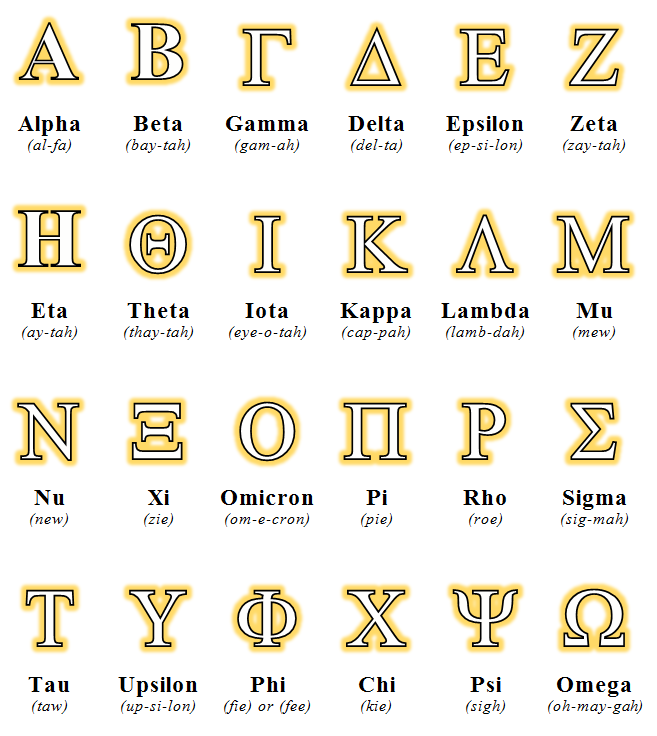
Greek Alphabet and Glossary
An initiated, dues-paying member who is enrolled in the university.
An alumnus or group of alumni who serve as a resource for the chapter members and liaison between the national organization and the local chapter.
A member of the organization that has graduated from college and continues to stay active with the organization by way of a graduate or alumni chapter.
Also known as a pin, it is an item of jewelry/insignia given to members upon initiation. The badge is to be worn at all official functions. In some organizations, upon a member's death it is returned to the sorority or fraternity headquarters. The badge must be worn with business like attire, usually over the heart and above all other pins.
A formal invitation to join a fraternity or sorority.
Nickname for big sister or brother, a mentor assigned to a new member.
A yell used mostly by NPHC organizations (although some other orgs have calls as well). Used to identify and greet brothers and sisters. For example, Alpha Kappa Alpha's call is SKEE-WEE. Non-members are not permitted to use the call.
The local collegiate branch of a fraternity or sorority.
A weekly meeting held to discuss sorority or fraternity business.
The official document drafted by an Inter/National fraternity or sorority that allows for the creation of a local chapter that is affiliated with a college or university campus.
A term used to name new members of a Panhellenic Council or Interfraternity Council organization who all joined during the same semester.
A newly formed, provisional group of an Inter/National organization. These groups usually receive higher levels of support from the parent organization, and will have a list of requirements to complete before being granted their own charter. The initial group of students who work to (re)establish a fraternity/sorority are referred to as “founders.”
An opportunity for Panhellenic sorority chapters that do not reach total (aka average or median chapter size) to extend invitations to join up until the chapter reaches total. This process is less formal, and not all chapters will participate throughout the year as it depends on membership size for the specific Panhellenic sorority. For more information about which Panhellenic sorority is participating in this process, follow @ucsbpanhellenic on instagram.
Insignia used by sorority and fraternity members. Most Greek lettered organizations reserve the crest for initiated members only. Each crest has hidden, secret meanings behind it. Also known as a coat or arms or shield.
The quarterly membership fee charged by fraternities and sororities. Dues cover the cost of operation, events, activities and socials.
A group of individuals bound together by ritual, common ideals, and a strong bond of friendship and brotherhood or sisterhood.
An event celebrated by fraternities and sororities to highlight the founding of their organization and celebrate its history. It's not necessarily held on the day the organization was founded.
Members of a fraternity or sorority. The term “Greek” is used because a majority of fraternities and sororities use Greek letters to distinguish themselves.
An organized week of activities to unite all councils.
The University of California has a zero-tolerance policy in regards to hazing. Hazing is defined as any action taken which produces bodily harm or danger, mental or physical discomfort, embarrassment, harassment, fright, or ridicule. Permission or approval does not make hazing acceptable, legal, or defensible. Once a common tradition, hazing has been banned by all national, local, and international fraternal organizations and institutions of higher education. The University of California, Santa Barbara strictly enforces this policy, and organizations found in violation are subject to immediate suspension of campus recognition and privileges, as well as negative legal repercussions.
A physical facility, usually used to house members, hold meetings and other events. Only CPC and IFC chapters at UCSB have chapter facilities in Isla Vista.
The entity that holds the title to property that a chapter lives or meets in. This is usually an alumni group like an advisory board. Not all organizations with chapter facilities have a House Corporation.
A person hired to live in the chapter house and supervise the chapter members. All CPC sororities employ a house director to take care of sorority house operations.
Infractions can be given to any fraternity or sorority that violates a rule or policy outlined in its respective council’s governing documents.
A traditional ceremony that brings a new member into full membership of a sorority or fraternity. Once you are initiated into an NPC sorority, you are ineligible for membership in any other.
Term for the process by which culturally-based fraternal organization members are selected to become new members of a chapter. This process tends to be more secretive than IFC or Panhellenic recruitment, but generally includes an application and an interview process, followed by an educational program done at the campus or regional level, then an initiation (generally known as “crossing”).
To be a legacy means that you have an older family member (brother, sister, mother, father, grandmother, or grandfather) who was a member of a Greek organization. Panhellenic does not review legacy information and it is not a factor in the recruitment process.
The first Greek letter of each Greek word that makes up the motto of a particular fraternity or sorority; these are generally displayed on clothing and other Greek paraphernalia.
A statement or letter from an alumnus/alumna or an active member of a fraternity/sorority, which recommends a prospective member for membership. Please note: letters of recommendation are not reviewed by any council/chapter at UCSB.
A culturally-based fraternal organization term somewhat equivalent to a new member class. They are the potential new members of the organization, and are often given names.
A term in some culture- and identity-based fraternities and sororities denoting the newest initiated members of the organization.
After receiving and accepting a Bid, the person becomes a new member. Formerly called a pledge (and still called a pledge in some organizations).
Philanthropy is a term used to describe charitable events performed by Greek organizations.
Refers to the cause or charity that each chapter/national organization chooses to support with their philanthropic dollars. Each organization supports a different cause or charity.
Any individual considering going through a recruitment process in interest of joining a sorority or fraternity.
A term in some culture- and identity-based fraternities and sororities signifying an older member in the organization. Prophytes can have either active or alum status.
A Panhellenic specific term describing the number of potential members each Panhellenic sorority can offer bids to during primary recruitment. This is determined by a formula involving the number of chapters and the number of individuals participating in the last step of Panhellenic primary recruitment. Quota adapts to the number of potential members going through primary recruitment: if there are more people interested in recruitment, quota increase to accommodate the growth.
The process where sororities and fraternities take in new members.
A secret ceremony of a Greek organization. Ritual elements are sacred to each sorority and fraternity and have been handed down through the generations. Only initiated members are exposed to the secret rituals of their fraternity or sorority.
A sorority member who is disassociated from her sorority to serve as a recruitment guide. Each PNM will be assigned a rho gam during formal recruitment.
Learn more: FSL Handout